A good product video shows the product being used by the people it’s made for, proves its main claims on screen, and looks good enough that people trust the product behind it. It’s planned around where it’ll be watched, usually short, and ends with one clear next step for the viewer.
Search for “product video” and you’ll mostly find AI generators, template tools and stock footage. They’ll give you something that moves. Whether it sells anything is another matter. We’ve made product films for Saint-Gobain Abrasives, Genesis and Weber in body shops, garages, on tiling jobs and in the studio, and the same handful of things decide whether a product film works. Here they are.
What is a product video?
A product video shows what a product does, how it works and why it’s worth buying. It goes by a few names (product demo, launch film, explainer, how-to) and they overlap, but they usually fall into one of these:
| Type | What it’s for | An example of ours |
|---|---|---|
| Product demo | Showing the product doing its job, so people can see it works | Norton Sustainable Discs cutting steel, aluminium, paving slabs and tiles |
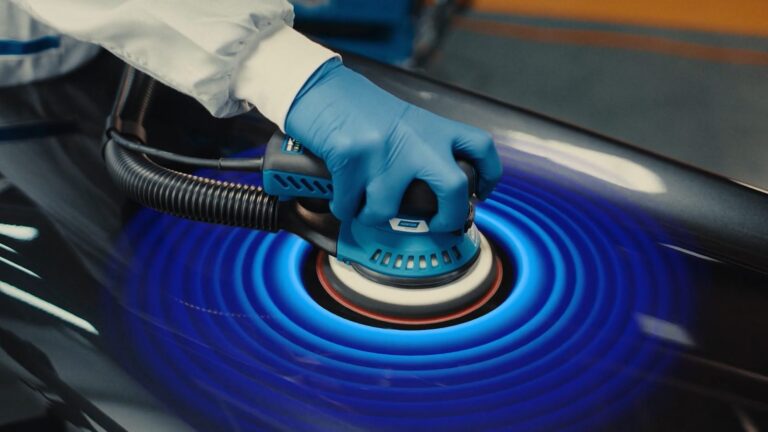
| Launch film | A hero film for a new product, with cut-downs for every channel | The Norton Electric Sander launch, shot in a prestige body shop |
| 3D product animation | Showing what’s inside, or what a camera can’t see | Genesis STRATO, a 3mm tile membrane explained in 3D |
| How-to or installation guide | Helping customers and installers get it right first time | Verona’s ClickLux 3D installation guide |
| Social and language versions | Teasers, short edits and translated versions of the main film | Sustainable Discs in English, Polish, German and French |
Most launches need two or three of these, which is why we plan them together from the start.
Seven things that make a good product video
1. It’s made for one audience, in one place
A film for a trade show stand plays with the sound off to people walking past. A film for a distributor’s training session gets watched start to finish. A social edit has about a second to stop someone scrolling. Decide who’s watching and where before anything else, because it changes the length, the pace, the words and whether you need subtitles. For Norton’s Sustainable Discs the audience was DIYers, so the film had to talk their language and keep the corporate jargon out.
2. It shows the product in use, where people use it
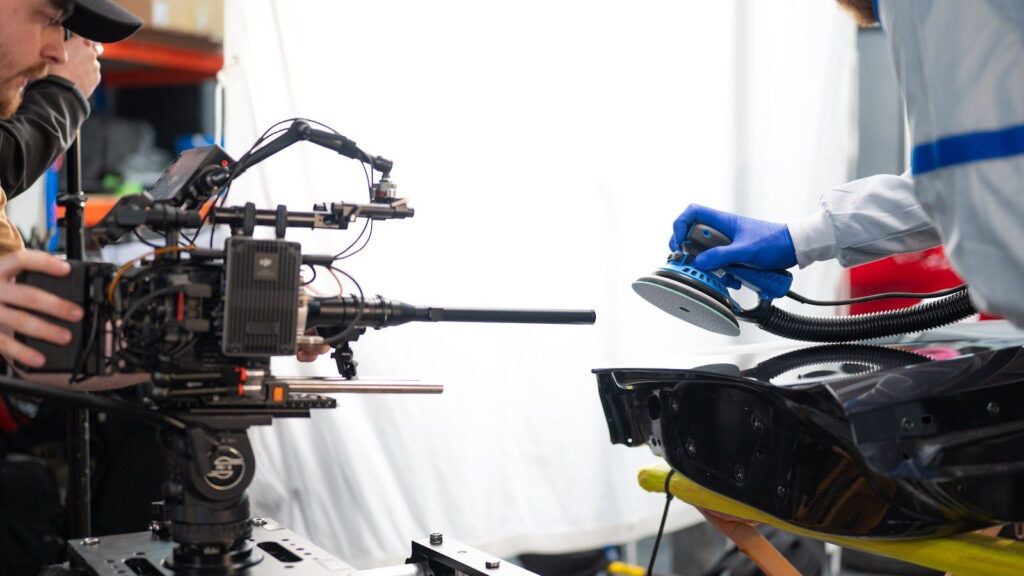
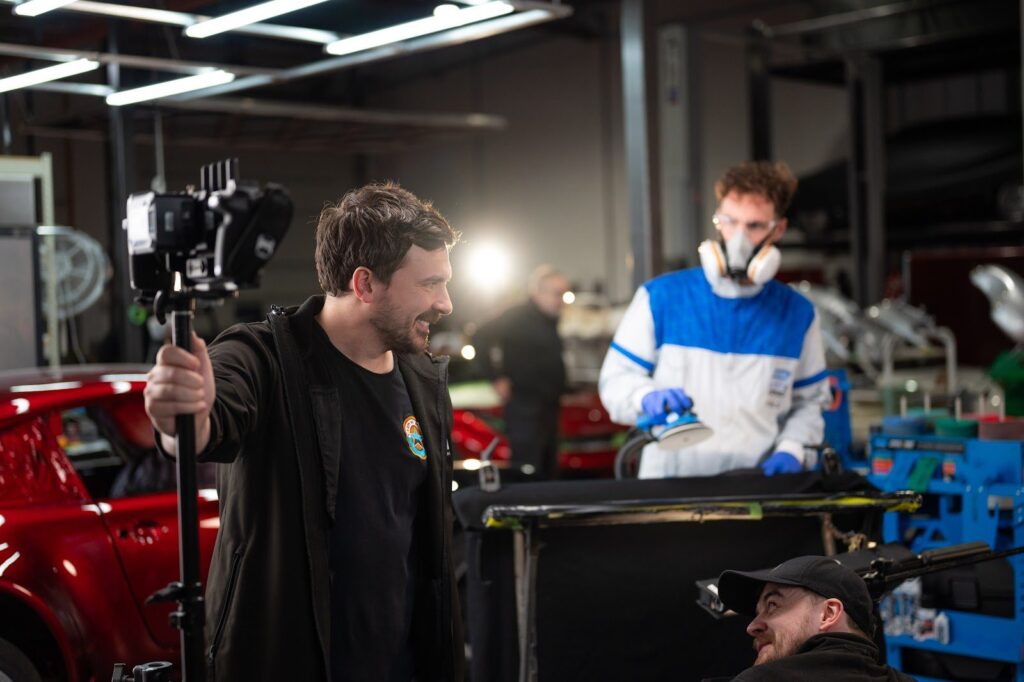
For the Norton Electric Sander, a glossy studio set would have saved us a 600-mile round trip. We made the trip anyway, to a body shop specialising in prestige cars, because the sander is built for professionals and the film had to show it where they work. (Some of the team are petrolheads, so nobody complained.) The Sustainable Discs were filmed in a garage at a house in the North East, which is exactly where a DIYer would use them.
3. It proves its claims on screen
Every product has a list of selling points. A good film turns each one into something you can see. Genesis needed every one of STRATO’s points in its launch film: it rolls out flat, it’s easy to install, it stops tiles cracking and it’s only 3mm thick. So we filmed the whole installation in live action, then used 3D for the points a camera couldn’t show. For the Sustainable Discs, every disc had a use case to cover, so we worked through stainless steel tubes, aluminium, paving slabs, tiles and PVC pipe, with each cut shot in slow motion at 240fps.
4. It shows what a camera can’t
Some of the best bits of a product are hidden inside it. That’s where 3D earns its place. The Norton sander film cuts from live action to 3D breakaway moments that explain features you couldn’t show with a camera, and our STRATO 3D animation mixes live action, 2D and 3D so the bits you couldn’t film still get seen.
5. The product looks its best
People judge the product by the film. Garages and workshops are full of flat, harsh overhead light, which is great for working and terrible for filming. On the sander shoot our gaffer, Roberto Colapietro, built a lighting rig he could control from an iPad, so the light rose as the camera pulled back on the hero reveal. We also used a probe lens to get right in among the controls and the sanding surface. (Brilliant pictures. A complete faff to use. Worth it.) Then the grade keeps the product colours accurate and the branding strong.
6. It’s planned and storyboarded before the shoot
We go into every product shoot with a storyboard the client has signed off. For the sander, that meant every shot listed in advance: branding, close-ups of the LED indicators and speed controls, the hose, disc changes, the trolley reveal, the 3D moments and the final hero shots. It means nothing gets forgotten on the day, and it saves hours in the edit. You can see the full story in our Norton sander product video write-up.
7. It’s built for everywhere it’ll be used
A launch needs more than one film. The sander shoot was planned to produce the main film, short social edits, product hero shots and brand photography from the same days. The Sustainable Discs campaign went out with a hero film and a teaser in each of four languages. We listened to around 40 voiceover artists per language, shortlisted five and let Norton pick, then rebuilt every graphic and on-screen line for each market. (Please don’t use AI voices. Everyone can tell.)
Live action, 3D or both?
If the product is something people hold and use, live action shows it best: hands, sparks, dust, the sound of it working. If the important part is inside the product, too small to see, or not made yet, 3D animation does it better. Plenty of our product films use both, filming the product in use and switching to 3D for the features. We’ve gone into the choice in more detail in 2D vs 3D animation.
How long should a product video be?
As short as it can be while still proving the point. A social teaser might be a few seconds; a launch film usually runs a minute or two; an installation guide is as long as the job takes to explain, because people watch those with the product in front of them. That’s another reason to plan the cut-downs at the start: one shoot can give you all three.
How much does a product video cost?
Short, simple films start from around £3,000 + VAT, and most of our projects cost £4,000–£8,000, often a main film with cut-downs or a small set of videos. Larger campaigns, and most 3D product animation, start from around £10,000 + VAT.
The biggest factors are how many shoot days and locations you need, whether there’s 3D in it, and how many versions you want at the end (cut-downs, languages, stills). Every project is quoted to its brief.
Product video FAQs
What is a product video called?
It depends on the job. A film showing the product working is a product demo. A hero film for a new product is a launch film or product commercial. One that shows how to fit or use it is a how-to or installation video, and an animated one is usually called a product explainer or 3D product animation.
How do I create a product video?
Start with who it’s for and where they’ll watch it. Then list the claims the film has to prove, plan a storyboard, shoot the product being used, add 3D or graphics for anything the camera can’t show, and edit a main film plus the shorter versions you need. With us, the shoot is usually a day or two and two rounds of changes are included as standard.
Can AI make a product video?
AI tools can turn product photos into a moving slideshow with a generated voice, and for a quick listing video that might be enough. What they can’t do is put your product in the hands of the people who use it, light it so it looks its best or prove a claim on camera. We’ve written more on choosing a video agency over AI.
Should I film the product myself?
For quick social clips, a phone and a window can work. For a launch film, a demo your sales team will use for years, or anything that has to look as good as the product, it’s worth bringing in a crew with the lights, lenses and time to get it right.
Got a product launch coming up?
Tell us about the product and when it launches, and we’ll plan the film, the cut-downs and the photos together. Have a look at our product video production work, or get in touch and we’ll talk it through.